
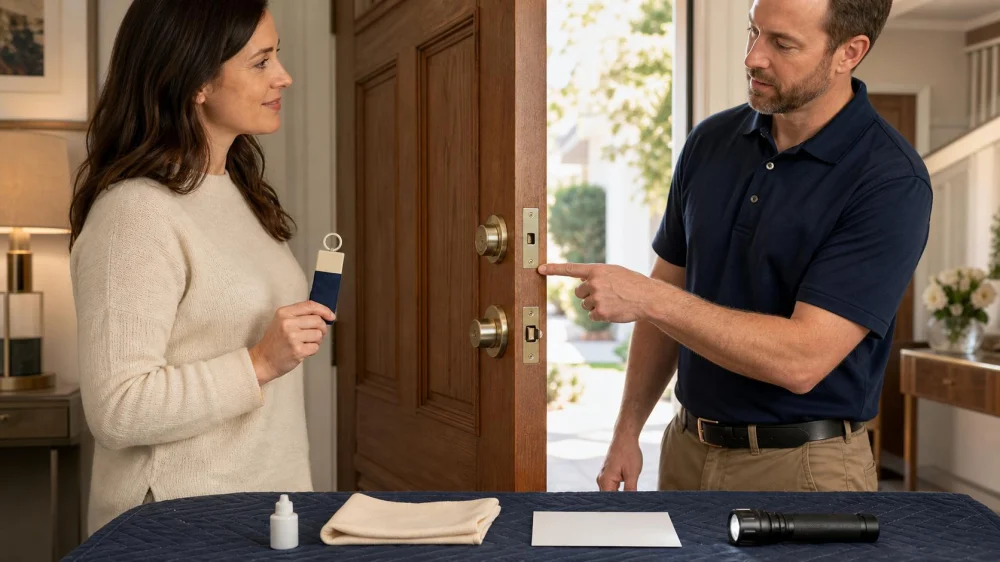
Door Lock Lubrication Guide: Use the Right Product and Know When to Stop
On this page
- Quick answer
- Confirm the problem is actually the lock
- Identify the part that feels stiff
- Choose a compatible product
- Prepare without contaminating the lock
- Apply a minimal amount
- Test gently
- Handle weather-related stiffness
- Treat smart and electronic locks carefully
- Avoid common lubrication mistakes
- Warning signs to stop DIY
- What a locksmith can inspect
- Build a simple maintenance schedule
- Maintenance checklist
- Frequently asked questions
- Next steps
Quick answer
Do not lubricate a lock until you know whether resistance comes from the keyway, latch, deadbolt, hinges, door alignment, weatherstripping, or electronic motor. Clean visible dirt without inserting tools, then check the lock manufacturer’s instructions for an approved product.
Use only a small amount at the specified point, keep overspray off finishes and electronics, and cycle the correct key gently. Stop if the key bends, the cylinder grinds, the deadbolt requires door pressure, the product produces dark debris, or operation does not improve quickly. Lubrication cannot repair broken springs, worn keys, damaged pins, misaligned doors, corrosion, or failing smart-lock components.

Confirm the problem is actually the lock
Test the door while it is open, if doing so is safe and authorized. If the key and bolt move smoothly with the door open but bind when closed, alignment, hinges, frame movement, or weatherstripping may be the issue.
If the handle is loose, latch does not retract, or deadbolt rubs the strike, lubricant in the keyway will not solve the underlying problem. Repeated force can break the key or damage hardware.
Compare with a second good key. A bent, cracked, heavily worn, or poorly duplicated key can feel like a bad lock. Do not force either key.
Listen and feel for scraping, clicking, motor strain, delayed retraction, or a spring that does not return. Record when the symptom occurs and whether temperature or humidity changes it.

Car Keys Express
LouisvilleJefferson CountyKentucky
12101 Sycamore Station Pl Suite 140, Louisville, KY 40299, USA
Identify the part that feels stiff
The keyway is the opening where the key enters. The cylinder is the keyed component that turns. The latch is spring-operated and usually retracts with the knob or lever. The deadbolt moves separately and should extend into the strike without relying on spring action.
Hinges support the door and can sag or wear. The strike plate receives the latch or bolt. Weatherstripping may push the door away from its normal position.
A multipoint lock has several locking points connected by internal hardware. Patio, storm, screen, vehicle, cabinet, safe, and high-security locks use different mechanisms.
Do not apply one product everywhere. A hinge lubricant may be wrong for a precision cylinder, and a lock product may damage paint, rubber, plastic, or electronics.
Choose a compatible product
Start with the lock or door manufacturer’s current maintenance instructions. Some specify a dry lubricant, a particular synthetic product, or no field lubrication. Warranty terms may depend on approved care.
Dry products can reduce sticky residue, while certain wet products may protect exposed mechanisms. “Dry,” “graphite,” “PTFE,” “silicone,” “white lithium,” and “penetrating oil” describe different materials and uses, not interchangeable choices.
Never assume a household oil, cooking spray, grease, or general-purpose aerosol is safe. It can attract dust, gum up pins, migrate into electronics, stain a door, or degrade seals.
If previous products are unknown, ask a locksmith. Mixing powders and oils can form abrasive paste that is harder to remove.
Prepare without contaminating the lock
Read the product label and safety data. Use ventilation, eye protection, and surface protection as directed. Keep children, pets, flames, and ignition sources away.
Wipe the key with a clean dry cloth. Remove visible dirt around the lock face using a soft cloth or brush without pushing debris into openings.
Protect painted, plated, wood, glass, stone, and plastic surfaces. Test product compatibility in an inconspicuous location when the manufacturer permits.
Do not use compressed air at high pressure. It can drive grit deeper, propel debris, or damage electronic seals.
Apply a minimal amount
Follow the approved product’s nozzle and quantity instructions. More is not better. Excess lubricant can run down the door, attract contamination, and migrate into parts that should remain dry.
For a manufacturer-approved keyway product, a small controlled application may be placed as directed, then distributed using a clean correct key. Do not insert applicators deep into the cylinder.
For exposed latch or bolt surfaces, use only the specified product at the specified contact point. Avoid the strike, paint, seals, and floor unless instructions include them.
Wipe away excess immediately with a compatible cloth. Dispose of oily or chemical materials according to the label because some can be combustible.
Test gently
Insert the correct key without force. Move it only through its normal range several times. Stop if it catches, bends, grinds, or requires increasing effort.
Operate the latch and deadbolt with the door open, then closed. Compare. If only closed-door operation binds, do not keep adding product.
Check that the bolt fully retracts and extends, the key can be removed in its normal position, and the door remains secure.
Wait and retest according to product instructions. Some carriers need time to evaporate. Continued wet residue or dark runoff should be assessed.
Handle weather-related stiffness
Cold can thicken inappropriate lubricants, shrink materials, freeze moisture, and change door alignment. Heat and humidity can swell doors or weatherstripping and move frames.
Do not pour hot water into a frozen lock. It can refreeze and contribute to corrosion. Do not use an open flame or high-heat tool near the door.
Use a manufacturer-approved deicing method only for the affected lock and finish. A locksmith can address recurring moisture entry, worn seals, corrosion, or alignment.
If stiffness follows seasonal door movement, hinge, strike, and frame correction may be more effective than cylinder lubrication.
Treat smart and electronic locks carefully
Follow the smart-lock manufacturer’s maintenance guide. Liquids, powders, and aerosols can migrate into motors, sensors, keypads, battery compartments, contacts, and seals.
Replace batteries with the specified type and inspect for corrosion without touching leaked material. Dispose of batteries properly.
Separate mechanical and electronic symptoms. A manual key that binds suggests a mechanical issue; a motor that stalls only when the door is closed may indicate bolt alignment; inconsistent keypad response may be electronic.
Do not dismantle a connected lock without preserving authorization, settings, codes, and warranty requirements. Use vendor support or a qualified locksmith.
Avoid common lubrication mistakes
Do not combine graphite with oil or apply layer after layer of different sprays. Unknown mixtures trap debris and can block fine tolerances.
Do not use the key to pull the door toward you while turning. Use the handle and correct alignment.
Do not spray through every hole in a lockset. Fastener openings, drain slots, speakers, and sensors are not lubrication points.
Do not lubricate to hide a security problem. Loose cylinders, pried hardware, damaged strikes, and unexplained scratches require inspection.
Do not service a lock you are not authorized to alter. Rentals, common areas, workplaces, safes, vehicles, mail equipment, and institutional hardware may have controlled maintenance.
Warning signs to stop DIY
Stop if the key is bent, cracked, stuck, or partially broken; the cylinder spins loosely; the handle does not return; the bolt will not retract; or internal pieces are visible.
Grinding, metal shavings, black paste, corrosion flakes, burnt odor, battery heat, or repeated motor failure require professional attention.
Stop when the door must be lifted, slammed, pushed, or pulled to lock. This points to alignment, hinge, frame, or foundation movement.
After burglary, attempted entry, fire, flooding, or impact, prioritize a security and safety inspection rather than routine lubrication.
What a locksmith can inspect
A locksmith can compare keys, inspect the cylinder, check fasteners, test latch and bolt travel, measure alignment, identify contamination, and evaluate wear.
The technician can clean or service approved components, originate a correct key, adjust compatible hardware, rekey when appropriate, or recommend replacement.
Ask for the cause, options, parts, labor, warranty, and future maintenance in writing. If drilling or replacement is proposed, ask why service or adjustment is not practical.
Door carpentry, frame repair, access control, alarm work, and structural movement may require other qualified trades.
Build a simple maintenance schedule
Inspect exterior door operation at seasonal changes and after weather events. Clean visible dirt, check screws and alignment visually, and retire worn keys.
Lubricate only at the interval and locations recommended by the manufacturer. Some products need very infrequent service; overmaintenance causes problems.
Record product name, date, location, symptom, and result. This prevents incompatible mixtures and helps a locksmith diagnose recurring trouble.
For commercial or shared systems, coordinate maintenance with the key-control and access-control administrator.
Maintenance checklist
- Test operation with the door open and closed.
- Compare a second undamaged authorized key.
- Identify keyway, latch, deadbolt, hinge, strike, or motor symptoms.
- Read current manufacturer instructions and warranty terms.
- Confirm product compatibility with lock, finish, seals, and electronics.
- Use minimal product only at approved points.
- Wipe excess and dispose of materials safely.
- Stop at grinding, bending, leakage, or continued binding.
- Record the product and service date.
Frequently asked questions
Is graphite best for every door lock?
No. Lock designs and manufacturer recommendations differ. Graphite can mix badly with existing oils and is unsuitable for some equipment.
Can I use a general-purpose penetrating spray?
Only if the lock manufacturer specifically approves it for that component. General sprays may attract dirt, harm finishes, or enter electronics.
Why does the deadbolt work when the door is open but not closed?
The bolt and strike may be misaligned because of hinges, frame movement, weatherstripping, or seasonal swelling. More keyway lubricant will not correct that geometry.
How often should a lock be lubricated?
Follow the manufacturer’s interval and environmental guidance. Frequent unsolicited spraying can create buildup; symptom-based diagnosis is more important.
Can lubrication fix a worn key?
No. A worn or bent key should be replaced from an appropriate source, and the lock should be checked if multiple keys bind.
Next steps
Test open-versus-closed operation, inspect the key, identify the affected part, and read the hardware instructions. Apply only a compatible product in a minimal amount. If binding remains or warning signs appear, stop and have a verified locksmith diagnose the key, cylinder, and door alignment.
This guide provides general maintenance information. Product compatibility, fire and egress requirements, authorization, and hardware service depend on the lock and location.


 KeyMe Locksmiths0.0 (0 reviews)
 Minute Key4.0 (16 reviews)
 Minute Key3.0 (7 reviews)
 Minute Key4.0 (7 reviews)
 Locksmiths Of Detroit5.0 (127 reviews)
 Lock Keypers Locksmith Services5.0 (15 reviews)
 How to Choose the Right Locksmith for High-Security Lock Installation
 Find a Cheap Locksmith Near Me in Omaha NE Today
 How to Protect Your Home from Lock Cracking: Locksmith Tips for Maximum Security
 How to Choose Between a Local Locksmith and a National Service
 How to Upgrade Your Front Door With High-Security Deadbolts
 How to Find a Licensed Locksmith Near Me in San Jose CA Quickly