
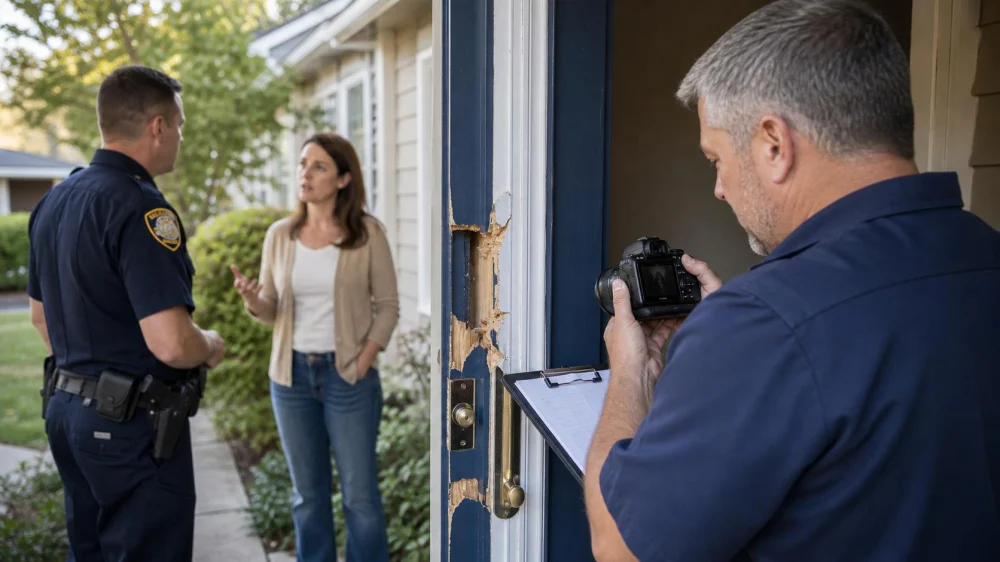
Door Lock Damaged After Forced Entry? Preserve Evidence and Restore Security
On this page
- Quick answer
- Stay out and report danger
- Protect the scene and evidence
- Document damage after police clearance
- Arrange temporary security
- Assess the entire door opening
- Control keys, codes, and credentials
- Plan permanent repair
- Coordinate police, landlord, and insurance records
- Complete the security follow-up
Quick answer
If a door, frame, lock, strike, hinge, or nearby window shows possible forced-entry damage, do not go inside to investigate. Move to a safe location and call 911 if the intruder may still be present, anyone is hurt, or there is immediate danger. Otherwise contact local law enforcement using its property-crime reporting process and follow instructions before touching, cleaning, closing, or repairing the opening.
After police release the scene, photograph the damage, contact the landlord or property manager when applicable, notify insurance, and use a verified locksmith plus a qualified door or building professional. A new lock alone cannot restore security when the door slab, frame, strike area, hinges, wall attachment, glass, wiring, or access credentials are compromised.

Stay out and report danger
Do not enter because a door looks quiet or partly closed. Watch from a neighbor’s home, locked vehicle, or other safe place and avoid announcing your location publicly. Tell police about movement, voices, open doors or windows, weapons, smoke, gas odor, pets, children, medically vulnerable occupants, and any vehicle or person you observed.
USAGov’s crime reporting guidance directs people in immediate danger to call 911 and property-crime victims to contact local law enforcement. Do not confront, follow, film at close range, or block a suspected intruder.
Protect the scene and evidence
Until police give permission, avoid the damaged door, handles, lock, glass, tools, footprints, blood, dropped objects, mail, and disturbed belongings. Do not test the key, sweep fragments, move a broken strike, play with a camera, or invite multiple people inside. Weather protection and animal containment should wait for responder direction unless a life-safety emergency requires action.
Tell responders if you already touched or moved something; do not hide that fact. Preserve original camera files, doorbell alerts, smart-lock events, alarm notices, texts, and eyewitness notes. Avoid editing or repeatedly sharing images that may be evidence.
Document damage after police clearance
Once authorized, photograph the full doorway from both sides and close details of the lock, strike, frame, hinges, jamb, threshold, wall, glazing, and debris. Include a scale only without altering the scene. Record the date, time, weather, police report number, responding agency, and who entered after clearance.
Make an inventory of missing or damaged property without discarding packaging, serial numbers, receipts, or ownership records. Save access logs and export copies according to the product instructions before retention windows expire. Give originals to police or insurance only through verified channels and keep a copy when allowed.
Arrange temporary security
Ask police when repair work may begin. A locksmith can disable a compromised cylinder, rekey usable hardware, or install a temporary lock when the structure supports it. A door, glass, or board-up contractor may be needed to close the opening safely. The solution must preserve emergency egress and comply with fire, building, rental, and accessibility rules.
Do not improvise with furniture, ropes, screws, boards, or a padlock that could trap occupants or block responders. If the property cannot be secured, relocate people and valuables, use professional guard or property services if appropriate, and notify the insurer and owner.
Assess the entire door opening
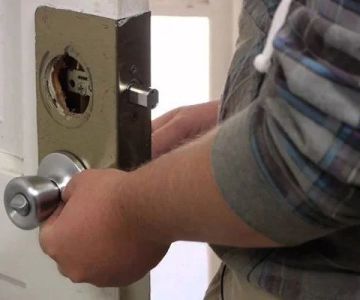
Have the professional check the door slab for splits and warping; the jamb and frame for cracks; the strike and reinforcement; hinge screws and leaf attachment; sidelights and glass; threshold; closer; weather seals; wall anchoring; and alignment. An undamaged-looking deadbolt may not hold if the surrounding wood or metal has failed.
For multifamily or commercial property, inspect shared access, fire doors, electrified hardware, alarms, intercoms, exit devices, card readers, and door-position sensors. Do not bypass a life-safety system to make the door latch. Coordinate the locksmith, door contractor, electrician, alarm provider, and code official as needed.
Control keys, codes, and credentials
Assume missing keys, fobs, access cards, garage remotes, lockbox codes, and written passwords may be compromised. Inventory every credential and tell the locksmith which cylinders share a key. Disable lost electronic credentials through an authorized administrator, change affected codes, and review event logs without deleting them.
Rekeying changes the cylinder so old keys no longer operate it; replacement changes the hardware. The right choice depends on damage, key control, code compliance, hardware grade, and compatibility. Notify residents or staff through a secure channel and document every new key or credential issued.
Plan permanent repair
Request a written scope that separates lock work, door and frame repair, glass, finish, electrical access control, alarm work, and structural attachment. Ask the contractor to identify what failed and how the proposed assembly meets the property’s use, local code, fire rating, accessibility, insurance, and manufacturer requirements.
Do not focus only on the most visible broken part. Restore alignment so the latch and deadbolt extend fully without force, but do not enlarge openings or remove rated labels casually. Test operation from both sides, emergency egress, closer behavior, alarm contact, and every authorized key before final payment.
Coordinate police, landlord, and insurance records
Contact the landlord or property manager promptly under the lease, but do not wait for a routine callback when the property is open or dangerous. Notify the insurer before permanent changes when practical and ask what photos, estimates, police reports, damaged parts, receipts, and mitigation records it requires.
Save itemized invoices showing service time, labor, parts, temporary work, permanent repair, and technician details. Avoid assigning insurance benefits or signing a broad authorization without understanding it. Keep the police report number separate from public social-media posts.
Complete the security follow-up
Review other entrances, windows, garage connections, gates, exterior lighting, cameras, alarms, mail, and spare-key locations with a qualified professional. Check accounts and identity protections if documents, devices, checks, or financial records were taken. USAGov also links victims to state and federal support resources.
Schedule a return inspection after the door settles and verify that temporary materials were removed. Update the key and credential inventory, emergency contacts, and incident log. Emotional effects after a break-in are real; use victim-support, counseling, or community resources when helpful.
 The Locksmith Express4.0 (45 reviews)
 Top Rated Locksmith5.0 (130 reviews)
 KeyMe Locksmiths3.0 (33 reviews)
 Minute Key3.0 (12 reviews)
 Minute Key0.0 (0 reviews)
 KeyMe Locksmiths5.0 (5 reviews)
 How to Build a Household Key and Access Code Plan
 How to Find a Licensed and Insured Locksmith Near Me Quickly
 How to Upgrade Your Business Security Without High Costs
 How to Install Window Locks to Prevent Easy Forced Entry
 How to Choose a Locksmith with Emergency Availability | Tips for Hiring a Locksmith
 The Benefits of Installing a Smart Lock with Mobile Access