
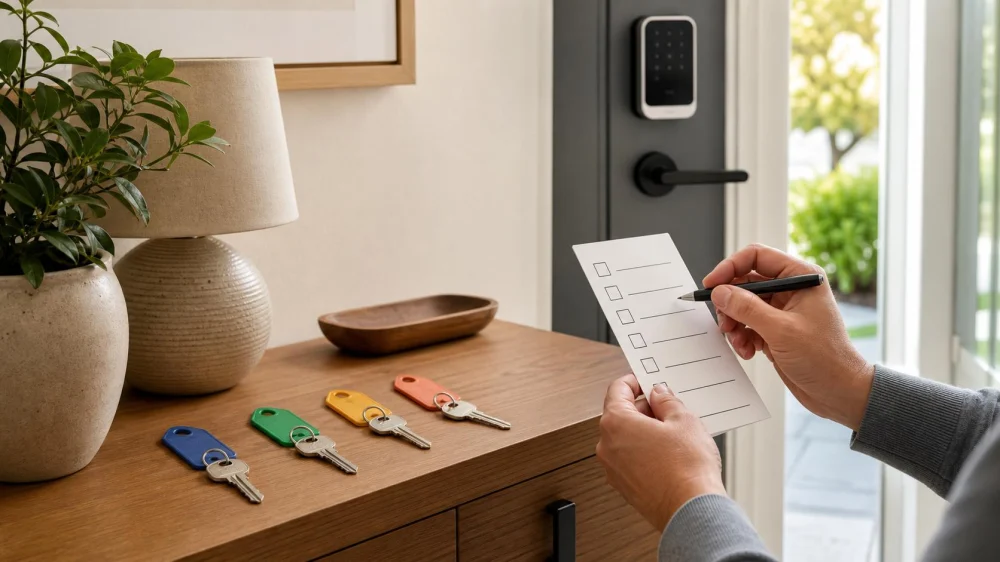
How to Build a Household Key and Access Code Plan
On this page
Quick answer
A household access plan is a simple record of every physical key, remote, code, app account, and emergency entry method, plus who can use it and when. Start with an inventory, give each person only necessary access, use separate temporary codes where supported, and revoke missing or outdated credentials promptly. Keep the record secure and review it regularly.

Barlow Lock & Security, Inc.
EffinghamEffingham CountyIllinois
1107 S Willow St, Effingham, IL 62401, USA
What household key control means
Household key control is the practice of tracking, issuing, recovering, and changing the credentials that unlock a home or its associated spaces. A credential may be a metal key, keypad PIN, garage remote, building fob, mobile app invitation, smart-lock account, or lockbox combination.
The goal is not to eliminate convenient access. It is to know which doors and devices exist, who is authorized, and what action to take when a key or code is no longer trustworthy. This is useful for families, roommates, landlords and tenants acting within their agreements, caregivers, cleaners, pet sitters, and short-term guests.

Inventory every access method
- List controlled openings. Record exterior doors, garage-entry doors, gates, storage areas, mailboxes, detached buildings, and shared entrances that you are authorized to manage.
- Identify each lock. Note whether it uses a mechanical key, keypad, fob, remote, app, or combination. Add the manufacturer and model only when you can verify them.
- Count issued credentials. Assign a neutral identifier such as “front key 03” rather than engraving an address or phone number on a key.
- Record authorized holders. Document the person, credential identifier, issue date, expected return date, and any access limits.
- Include hidden dependencies. Check garage-door apps, voice assistants, home-automation accounts, saved phone access, installer accounts, and backup mechanical keys.
Keep this inventory in a secure location. A detailed access list can itself be sensitive because it reveals how the property is entered. Do not post it on a refrigerator, share it in an open group chat, or store PINs beside labeled keys.
Assign only the access people need
Permanent household members may need broad, ongoing access. A cleaner, contractor, dog walker, or visiting relative may need one door during a limited window. When the hardware supports it, issue a distinct credential instead of sharing the household's main code. Separate credentials make revocation easier and can help identify which access remains active.
Best for ongoing access: an individually assigned key, code, or account with a clear owner. Best for temporary access: a time-limited or easily deleted code, provided the device supports it reliably. Not ideal: one shared PIN for family, vendors, guests, and emergencies, because changing it disrupts everyone and accountability is unclear.
Agree on basic rules: do not duplicate a key without permission, do not forward a code, do not prop secure doors open, and report a loss immediately. Retrieve physical credentials when a roommate moves, employment ends, a vendor relationship changes, or a lease requires return.
Manage codes and smart locks
- Change manufacturer-default credentials and complete ownership transfer according to official product instructions.
- Use a unique account password and enable multifactor authentication if the service offers it.
- Create individual codes rather than reusing a meaningful date, address fragment, or phone number.
- Remove expired guests and old phones, fobs, integrations, and administrator accounts.
- Review event history only if the household has agreed on appropriate privacy boundaries.
- Monitor battery condition and test the documented backup-entry method before it is needed.
- Install software or firmware updates using the manufacturer's supported process.
A smart lock is not automatically appropriate for every door. Consider account support, connectivity, batteries, accessibility, emergency egress, household comfort, and the quality of the door and frame. Do not rely on app features to compensate for hardware that binds or fails to latch.
Respond to a lost or unreturned key
- Identify what is missing. Determine which key, remote, fob, code, or account was exposed and which openings it controls.
- Assess context. Consider whether it was labeled, lost with identifying documents, stolen, copied, or retained by someone whose authorization ended.
- Revoke digital access. Delete the affected code, remote, fob, app user, or integration and confirm that the change reached the device.
- Restore mechanical key control. Ask a locksmith whether compatible, serviceable locks can be rekeyed or whether damaged or unsuitable hardware should be replaced.
- Update the inventory. Record the response, new credential identifiers, recipients, and any unresolved opening.
If a loss is connected to stalking, domestic violence, a burglary, or an immediate threat, ordinary access administration may be insufficient. Move to a safe place and contact appropriate emergency services or a qualified local support organization. Call 911 for an immediate danger in the United States.
Quarterly access checklist
- Confirm that the list of doors, gates, remotes, fobs, codes, apps, and administrators is complete.
- Remove people and devices that no longer need access.
- Recover overdue physical keys and deactivate credentials that cannot be recovered.
- Test locks, latches, deadbolts, batteries, and backup entry without defeating normal security.
- Check that emergency access plans still work for children, older adults, or people with disabilities.
- Verify that renters and managed-property residents remain within lease, building, and association rules.
- Schedule professional inspection for sticking, loose, damaged, or unreliable hardware.
Limits and safety notes
This checklist is general organizational guidance, not a site-specific security assessment or legal advice. Landlords, tenants, condominium residents, employers, and residents of shared buildings may have different authority and notice obligations. Fire, life-safety, accessibility, and building requirements can restrict what may be installed or changed.
Never obstruct required emergency egress, conceal a key where it is readily discoverable, or attempt destructive entry based on an online tutorial. If someone is locked in, a child or vulnerable person is at risk, or there is an active threat, use the appropriate emergency response rather than routine locksmith scheduling.
Frequently asked questions
How often should access codes be changed?
There is no universal calendar interval for every household. Change a shared or exposed code promptly, delete temporary codes when their purpose ends, and review active users regularly. Individual credentials reduce the need to change everyone at once.
Should spare keys be labeled?
Use an internal identifier that helps you manage the key without revealing the property address or door to a finder. Store the mapping separately in the secure inventory.
What if a former roommate does not return a key?
Document the missing credential, notify the owner or manager when applicable, and restore key control through an authorized rekey or replacement. Follow the lease and local rules rather than attempting an unauthorized lockout.
Can one code be shared with all service providers?
It can be convenient but is difficult to revoke selectively. Distinct, time-limited codes are preferable when supported and appropriate. Otherwise, use a documented key-issue and return process.
Who should have an emergency spare?
Choose a trusted person who can reach the property and understands when access is authorized. Consider privacy, distance, availability, and the needs of household members; document and periodically reconfirm the arrangement.
Evidence notes
The inventory, least-necessary-access, revocation, and review practices above are general security-management principles adapted for households. Device-specific reset, battery, account, and update steps should come from the verified manufacturer instructions. When hiring home-service providers, broad Federal Trade Commission consumer guidance supports researching providers, clarifying work, and paying carefully. State and local authorities are the appropriate sources for licensing and property rules.
Conclusion and next steps
Begin with a 20-minute access inventory, then close the most obvious gaps: unknown key holders, shared vendor codes, former app users, unreliable locks, and untested backup entry. If mechanical key control cannot be confirmed, use Locksmith Finder to identify local locksmith options and request an itemized assessment. A useful plan stays small, secure, current, and easy for the household to follow.


 KeyMe Locksmiths4.0 (24 reviews)
 KeyMe Locksmiths4.0 (7 reviews)
 KeyMe Locksmiths4.0 (48 reviews)
 FCL Security4.0 (28 reviews)
 Minute Key3.0 (8 reviews)
 KeyMe Locksmiths4.0 (18 reviews)
 Locksmith Tips for Choosing the Right Door Hardware
 How to Choose the Right Locksmith for High-Security Lock Installation
 What to Expect When Calling a 24 Hour Locksmith Near Me
 Can a Locksmith Near Me Fix Broken Door Locks Without Replacement | Expert Insights
 How Locksmiths Unlock Cars Without Keys Using Professional Tools
 How to Protect Your Home From Lock Picking Tools