
Historic Door Lock Repair: Preserve Hardware and Function
On this page
Quick answer
Before repairing a historic door lock, identify the lock type, photograph every faceplate and fastener, and test whether the problem comes from the mechanism or door alignment. Preserve reversible options first: cleaning, correct lubrication, spring or spindle repair, compatible keys, and careful strike adjustment. Upgrade security separately when necessary without discarding original hardware automatically.

Identify what is original
Older doors may use rim locks mounted on the surface, mortise locks set inside the door edge, box locks, skeleton or bit keys, early cylinders, ornate knobs, escutcheons, or thumb latches. Parts may be original, period replacements, or modern components fitted into old trim. Age alone does not prove historical significance.
Look for construction method, finish, screw type, maker marks, patents, and evidence of earlier holes. Do not scrub marks away. If the building is locally designated, museum-quality, or subject to an easement, consult the preservation authority before removal. A preservation architect, architectural conservator, or locksmith experienced with historic hardware can help classify it.

Document before removal
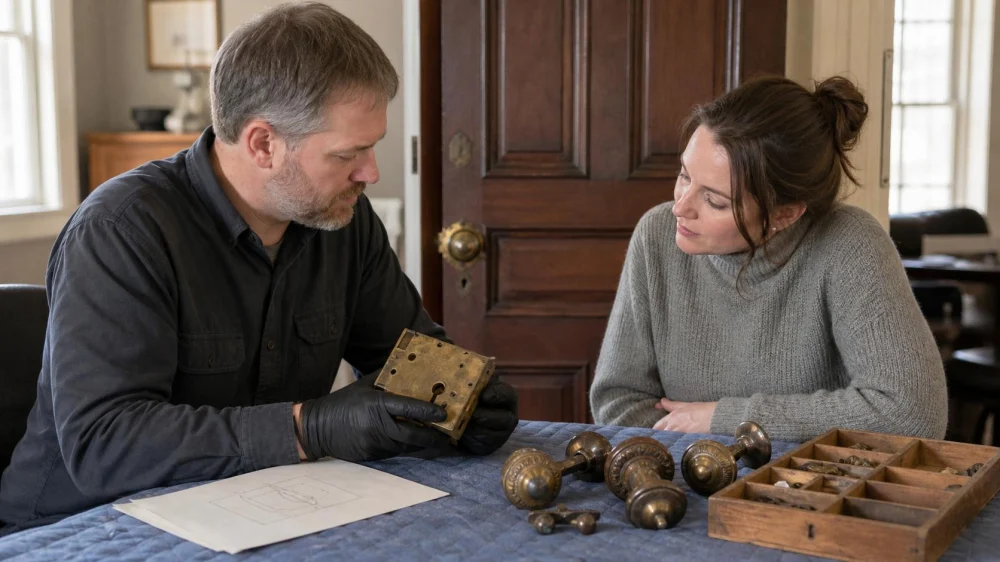
Photograph the full door on both sides, then take close views of knobs, roses, keyholes, edge plates, strike, hinges, gaps, and fasteners. Include a ruler without covering details. Record which direction the door swings, approximate thickness, backset, spindle dimensions, and the position of every washer or spacer.
Use labelled trays to keep screws and small parts with the correct door. Do not mix hardware from several openings. Avoid power drivers on fragile slotted screws; a poorly fitting bit can damage the head and surrounding finish. Support heavy knobs and lock cases during removal so they do not tear veneer or fall inside the door.
Separate lock and door problems
Test the mechanism gently with the door open and then closed. If the latch or bolt moves freely while open but binds when closed, alignment, hinge wear, swelling, or frame movement may be involved. If the knob turns without retracting the latch, the spindle, hub, set screw, spring, or internal linkage may be worn.
Do not force a brittle key. A key that once worked can fail because the door loads the bolt, the key is worn, or internal parts are dirty or broken. Inspect the door for sag, loose hinges, altered weatherstripping, and paint buildup before modifying the lock. Correcting the door can preserve more original metal.
Compare repair options
A skilled technician may disassemble the case, remove loose debris, use a manufacturer- or material-appropriate lubricant, repair or reproduce a spring, fit a spindle, secure a knob, or make a compatible key. Missing parts may be found as salvage, fabricated, or replaced with reversible reproduction hardware. Ask which parts will remain original.
Avoid aggressive polishing that removes patina, plating, or tool marks. Chemical dips, wire wheels, and abrasive compounds can permanently change the surface. Ask for a small finish test in an inconspicuous area and define whether the goal is conservation, gentle cleaning, or a bright restored appearance. Keep every removed part, even if it no longer functions.
Balance preservation and security
A historic latch may not meet current security, fire, accessibility, or egress needs. It can sometimes remain as decorative or secondary hardware while a compatible modern lock provides required function. Placement should avoid cutting important moulding, weakening the door, or creating an irreversible hole when a less invasive option exists.
Exterior, rental, multifamily, commercial, and fire-rated doors have different requirements. Consult the applicable building or fire authority and a qualified professional. Do not add a double-cylinder or surface device that prevents prompt interior exit. Security upgrades should account for the frame, hinges, glazing, and strike support, not the lock alone.
Reinstall and record the work
Reinstall with correct fasteners and without stripping old wood. The knob should turn smoothly, the latch should retract fully, and the door should close without slamming. Test all authorized keys with the door open and closed. Confirm that occupants can exit easily and that the bolt engages the strike to its intended depth.
Save before-and-after photographs, measurements, part descriptions, key count, care instructions, and the technician’s invoice. Store original parts in labelled archival-style bags or boxes rather than throwing them away. Future owners and conservators benefit from knowing what changed and which alterations are reversible.
Frequently asked questions
Should an old lock be replaced because it is hard to turn?
Not automatically. Door loading, dirt, worn keys, spindle problems, or a failed spring may be repairable. Evaluation should precede irreversible replacement.
Can a locksmith make a key for an old lock?
Often, depending on condition and key type. The technician may fit a key to the mechanism, but restricted or unusual systems need specialist knowledge and proper authorization.
Should brass hardware be polished brightly?
Only when that finish goal is informed and approved. Polishing can remove original lacquer, plating, patina, and evidence. Conservation often favours minimal cleaning.
Evidence and limitations
This guide combines common locksmith diagnosis with preservation principles: document first, retain original material, favour reversible work, test door alignment, and separate code upgrades from decorative value. Significance, material, listings, and legal requirements vary. A preservation professional and qualified locksmith should review valuable or regulated openings.
Conclusion and next steps
Photograph and measure the hardware, identify the lock type, and compare open-versus-closed function. Choose a technician who can explain repair, conservation, and security options without unnecessary removal. Keep original parts and a complete work record so the door remains understandable, serviceable, and safe.



 Minute Key3.0 (12 reviews)
 Beaver Dam Lock & Security4.0 (59 reviews)
 Minute Key3.0 (3 reviews)
 KeyMe Locksmiths3.0 (14 reviews)
 KeyMe Locksmiths4.0 (5 reviews)
 EZ LOCKSMITH4.0 (486 reviews)
 How to Install High-Security Locks on Your Windows and Doors
 Locksmith Tips for Choosing the Right Lock for Each Door Type
 How to Secure Your Windows and Sliding Doors From Forced Entry
 Understanding the Different Types of Locks and Their Uses
 The Benefits of Installing a Smart Lock on Your Garage Door | Locksmith Finder
 Can a Locksmith Near Me Fix Broken Door Locks Without Replacement | Expert Insights