
Key Copy Not Working? Safe Checks Before Cutting Another
On this page
Quick answer
If a new key copy does not work, stop forcing it. Confirm that you are testing the correct authorized lock, compare the copy with the working key for the same blank shape and obvious damage, and try the working key under the same door position. A copy that repeatedly sticks, fails to insert, or will not turn should be checked by the key cutter or a qualified locksmith.
A key copy is cut from an existing key’s visible pattern; it is not automatically an exact restoration of the lock’s original key specification. Wear in the source key, a mismatched blank, cutting error, burrs, or an unrelated lock or door problem can affect the result.

Identify the failure pattern
Before requesting another copy, note exactly what happens. A clear description helps separate a key problem from a lock or door problem.
- Will not enter: the blank profile may be wrong, the key may be bent, or debris or damage may be blocking the keyway.
- Enters only partway: the blank length, shoulder position, or profile may not match.
- Enters fully but will not turn: the cuts may be inaccurate, the copy may be based on a worn source, or the lock may be under load.
- Turns only when wiggled: the copy, source key, or lock may be worn. Repeated wiggling is not a dependable fix.
- Works in one lock but not another: the locks may not actually be keyed alike, or wear may differ between cylinders.
- Works with the door open but not closed: door or strike alignment may be loading the latch or bolt rather than the key being at fault.
Test only property you are authorized to access. If there is any uncertainty about ownership, permission, or which key belongs to which lock, pause and verify before continuing.
Safe key-copy checks
- Use good lighting. Examine the new key without putting fingers near sharp burrs or damaged edges.
- Confirm the matching original. Compare it with the known working key used for that exact lock, not a similar household key.
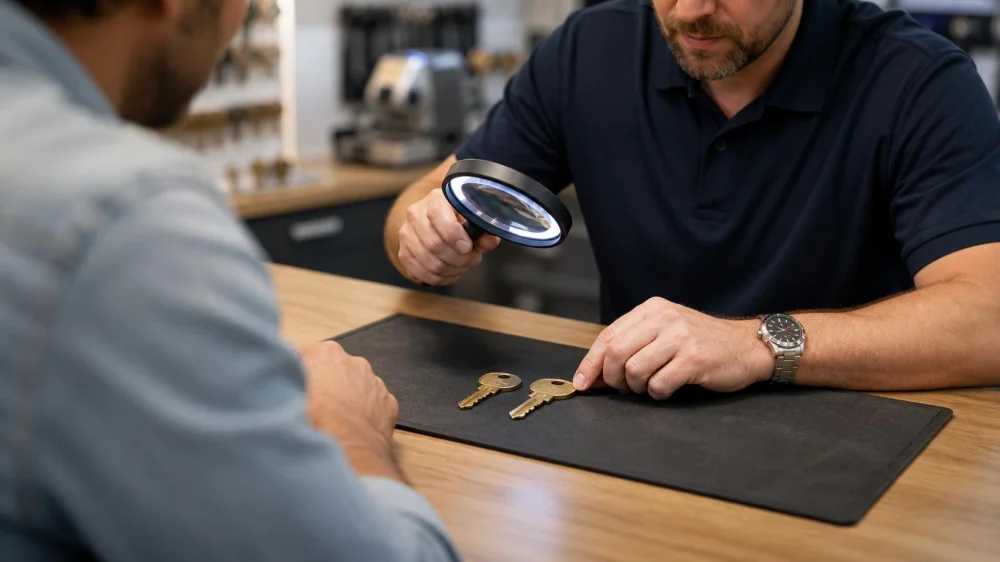
- Compare blank features. Look at overall length, groove pattern, shoulder or stop position, tip shape, and head orientation. Do not rely on head color alone.
- Look for obvious defects. A bent blade, rough metal projection, deep gouge, crack, or visibly uneven cut is a reason to stop.
- Test the working key first. If the original also resists, the issue may involve the lock, weather, or door position.
- Unload the door gently. With ordinary exterior or interior doors, test whether light push or pull pressure changes how the working key operates. Do not force the handle, frame, or bolt.
- Try the copy once with normal pressure. Insert it straight and turn only as firmly as a known working key normally requires. Stop at unusual resistance.
- Record the result. Note whether insertion, turning, bolt movement, or key removal failed and whether the door was open or closed.
Do not file random cuts, hammer the key, bend it straight while inserted, add thick coatings, or use pliers to multiply turning force. These actions can damage the copy, break it in the cylinder, or obscure the cause.
What may cause a bad key copy
Wrong key blank
Two blanks may look similar while using different groove profiles, lengths, or stopping points. A blank should match the lock system, not just slide partway into the keyway.
Worn source key
A heavily worn duplicate can pass its inaccuracies to the next generation of copies. When available and authorized, an original specification, key code, or less-worn working key may provide a better basis. Whether code cutting is available depends on the lock and proof of authorization.
Cutting or finishing error
Incorrect depth or spacing can prevent the lock from operating. Rough projections left after cutting may also interfere. The cutter should inspect and correct its work rather than having the customer reshape the blade by guesswork.
Lock wear or contamination
A worn cylinder may tolerate one old key but reject a slightly different copy. Damage, corrosion, inappropriate lubricant, or foreign material can also affect insertion and turning. Keep liquids and improvised cleaners out of the keyway.
Door load or alignment
A key can appear faulty when the bolt is pressed against the strike. If both the original and copy behave differently with the door open, request an assessment of the door and lock rather than repeatedly recutting keys.
Return to the cutter or call a locksmith?
Return to the key cutter when the working original operates normally, the new copy has never worked, the blank or cuts look questionable, and the key is an ordinary type the shop agreed to duplicate. Bring the receipt and the authorized working key if it is safe to do so; avoid labeling keys with a home address.
Choose a qualified locksmith when the original also fails, the cylinder is damaged, a key is trapped or broken, several copies behave inconsistently, the door alignment affects operation, or the lock uses a controlled or specialized system. A locksmith should confirm authorization before originating keys or servicing the lock.
Contact the responsible provider for vehicle keys, building-managed systems, rented property, safes, access-control credentials, or manufacturer-controlled keys. These may involve programming, authorization records, property-management rules, or equipment-specific procedures beyond basic duplication.
Limitations and important notes
- This guide covers authorized troubleshooting, not lock bypass, impressioning, decoding, or entry without a working key.
- Do not post photographs of key cuts, key codes, access cards, or identifying tags online.
- Some keys are marked or contractually controlled. Follow the property owner’s, employer’s, manager’s, or system provider’s authorization process.
- A key that operates today but binds or requires unusual movement is not a reliable spare. Have it evaluated before an urgent lockout.
- If a key may have been copied or held without permission, address access security with the authorized owner instead of focusing only on whether the duplicate works.
Sources and evidence notes
The checks in this guide reflect common locksmith practice: compare the correct blank and source, distinguish insertion from turning and door-alignment symptoms, avoid excessive force, and verify authorization before service. Exact tolerances, key-control rules, and replacement options depend on the lock manufacturer and system.
Useful evidence for a service visit includes the working key, failed copy, receipt, lock brand or model information that is already visible, a description of the symptom, and proof of authority to request work. Do not dismantle the lock merely to collect more information.
Frequently asked questions
Should a new key copy look exactly like the original?
The groove profile, stopping features, and functional cut pattern should be appropriate for the lock, but head shape and finish can differ by blank manufacturer. A visual comparison cannot confirm cutting accuracy by itself.
Can I use the working key to wear in the new copy?
No deliberate wear-in process should be necessary. Repeatedly forcing or scraping a poor copy can damage the key or lock. Ask the cutter to inspect it.
Why does my copy work only one way up?
Some keys are designed to operate in one orientation, while others are reversible. Compare the lock and original key design. If a reversible copy works in only one orientation, the cuts may need professional inspection.
Can a hardware store fix a copy it made?
Many cutters will inspect a recent duplicate according to their service policy. Specialized, controlled, high-security, vehicle, or electronic keys may need an authorized locksmith, dealer, manager, or manufacturer channel.
When should I stop testing?
Stop when the key will not insert smoothly, requires abnormal force, bends, becomes trapped, produces metal debris, or causes the cylinder to move. A broken key or damaged lock is harder to resolve than an untested spare.
Next steps
Place the working key and failed copy side by side without photographing or sharing their cuts. Write down the exact failure point, test the working key under the same door position, and contact the original cutter if the lock operates normally. If both keys resist or the hardware is damaged, arrange an authorized locksmith inspection.

 KeyMe Locksmiths4.0 (88 reviews)
 Rightway Lock & Key3.0 (6 reviews)
 KeyMe Locksmiths3.0 (2 reviews)
 Minute Key4.0 (8 reviews)
 Auto Lock Specialists4.0 (140 reviews)
 KeyMe Locksmiths4.0 (16 reviews)
 How to Protect Your Garage From Theft Using Advanced Locks
 The Benefits of Installing a Smart Lock on Your Garage Door | Locksmith Finder
 How to Protect Your Business from Break-Ins: Locksmith Solutions
 How to Secure Sliding Glass Doors With Smart Locks and Deadbolts
 How to Protect Your Home From Burglars With Layered Security
 How to Protect Your Home From Lock Picking Tools