
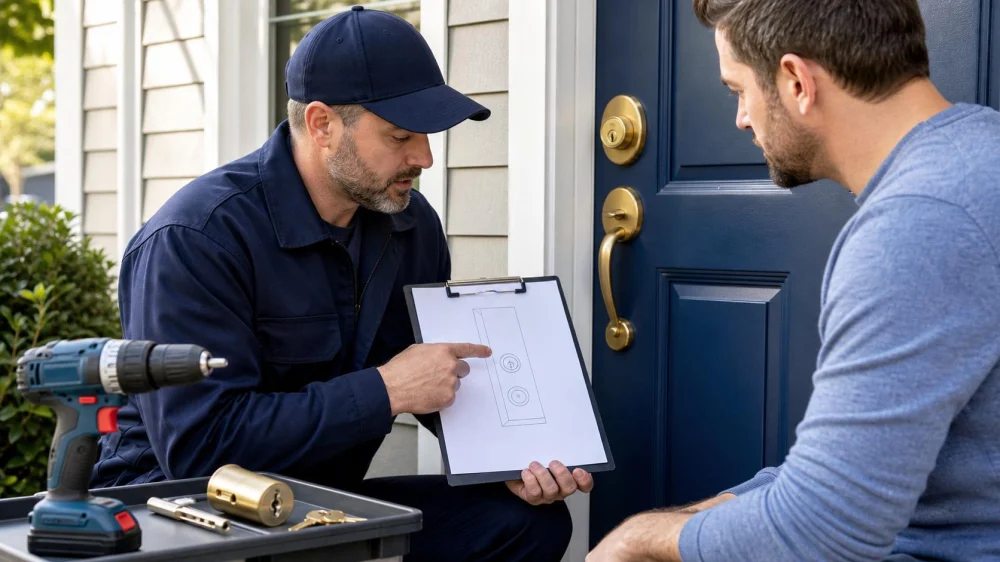
What to Confirm Before a Locksmith Drills a Lock
On this page
- Quick answer
- Ask for a specific diagnosis
- Review non-destructive alternatives
- Define the destructive-work boundary
- Choose replacement hardware first
- Document authority and price
- Test and record the result
- Pre-drilling checklist
- Limitations and emergency notes
- Frequently asked questions
- Official consumer guidance
- Ask for the drill decision in writing
Quick answer
Before drilling, ask the locksmith to identify the lock, explain why non-destructive entry is not appropriate or has failed, describe exactly what will be drilled, and state the risks to the cylinder, lock body, door, frame, finish, electronics, warranty, and access system. Approve the replacement hardware and total revised price before damage occurs. Photograph the existing condition and record your authorization.
Drilling can be a legitimate last-resort technique, but “every lock must be drilled” is not a credible universal rule.

Ask for a specific diagnosis
Have the locksmith name the lock type and the observed problem: lost key, failed cylinder, broken internal part, jammed bolt, electronic fault, damaged key, misaligned door, or another condition. A door that will not open may involve the latch or frame rather than the key cylinder.
Ask what inspection or tests support the diagnosis. Do not demand a public demonstration of bypass techniques or details that could reduce security. A competent explanation can remain high level while still identifying the failed component and decision.

Review non-destructive alternatives
Ask whether the locksmith considered authorized key retrieval, manufacturer or property-management support, decoding, picking, impressioning, key cutting, cylinder service, hinge or latch access where lawful and safe, electronic reset, or another method appropriate to the hardware. The answer depends on lock design, condition, authorization, time, and skill.
Non-destructive does not always mean faster, cheaper, or possible. Conversely, repeated attempts can damage a lock or delay access. Ask for the tradeoff and let the verified professional recommend a controlled sequence.
Define the destructive-work boundary
Confirm whether only a replaceable cylinder will be sacrificed or whether the lock case, trim, door, frame, glass, wiring, credential reader, or surrounding finish is at risk. Set a stop point requiring new approval if the first drilling plan does not work.
For a rented property, condominium, commercial building, vehicle, safe, restricted keyway, or connected access-control system, obtain owner, manager, fleet, insurer, manufacturer, or security integrator approval as required. Fire-rated and egress doors need particular care because unapproved modification can affect life safety.
Choose replacement hardware first
Do not wait until the door is open to learn that the correct replacement is unavailable. Confirm brand compatibility where relevant, dimensions, function, finish, keyway, grade or rating, electronics, handedness, rekeying, number of keys or credentials, and temporary-security plan.
Ask whether the replacement restores the original security and door function and whether additional door or frame repair will be needed. Record product and labor warranties and the responsible party for a return visit.
Document authority and price
Show acceptable proof that you control the property or have authorization. Ask for a revised written estimate listing entry attempt, drilling, labor, replacement hardware, rekeying, disposal, door repair, service call, after-hours charge, and tax. Approve a total or a clear change-order process.
Do not sign blank documents or accept pressure to begin before the price and consequences are explained. If a low call-center quote changes dramatically, pause and independently verify the company and technician.
Test and record the result
After replacement, test the door open and closed. Confirm smooth latch and bolt operation, alignment, key removal, inside egress, electronic credentials, battery or backup process, and any auto-lock setting. Never test a questionable lock by closing yourself outside.
Count keys and credentials, identify which old ones are invalid, photograph the completed hardware, and obtain an itemized invoice. Keep sensitive key codes and system details secure.
Pre-drilling checklist
- Verify locksmith identity and your authority.
- Record the lock type and diagnosis.
- Ask which non-destructive options were considered.
- Define exactly what may be damaged.
- Set a stop point for additional approval.
- Confirm suitable replacement hardware is available.
- Approve the revised itemized price.
- Test operation and collect records afterward.
Limitations and emergency notes
- This guide cannot determine the correct opening method for a specific lock.
- Do not attempt drilling or bypass based on online instructions.
- Lock, building, vehicle, lease, warranty, and licensing rules vary.
- Do not compromise an occupied property, safe, evidence container, or life-safety door without clear authority.
- For immediate danger behind a locked barrier, call emergency services.
Frequently asked questions
Does drilling always destroy the whole lock?
Damage depends on the lock and method; a cylinder may be replaceable, but surrounding hardware or the door can also be at risk.
Should every lock be pickable?
No. Design, condition, damage, access, and authorization affect whether non-destructive entry is feasible.
Can a landlord require a particular locksmith?
Lease and building rules may control the provider and hardware. Contact management before work when practical.
Who pays for door damage?
Clarify responsibility and insurance in writing before destructive work; applicable law and contract terms vary.
Should the old cylinder be returned?
Ask in advance. Disposal, warranty, evidence, core-return, and security considerations can affect the answer.
Official consumer guidance
The Ohio Attorney General advises consumers to be skeptical when told that breaking a lock is the only opening method and to get an estimate before work. Connecticut and Maryland regulators also warn about bait-and-switch pricing and recommend technician verification, upfront estimates, proof of access rights, and itemized invoices.
Ask for the drill decision in writing
Before the tool comes out, ask the locksmith to write the diagnosis, part to be drilled, expected damage, replacement, and revised total. Approve only after those five points match your authorization.

 KeyMe Locksmiths4.0 (58 reviews)
 KeyMe Locksmiths4.0 (20 reviews)
 KeyMe Locksmiths1.0 (1 reviews)
 Minute Key4.0 (11 reviews)
 KeyMe Locksmiths4.0 (28 reviews)
 KeyMe Locksmiths4.0 (9 reviews)
 How to Protect Your Home From Lock Prying and Tampering
 How to Protect Your Home From Intruders Using Smart Home Features
 What to Do If Your Key Won’t Come Out of the Lock | Locksmith Finder
 How to Protect Your Business from Break-Ins: Locksmith Solutions
 Locksmith Near Me in Colorado Springs CO for Reliable Lock Repairs: Trusted Local Guide
 How to Protect Your Business With Restricted Access Lock Systems - Expert Tips