
Lockbox Code Handoff: Change, Test, and Record Access
A lockbox can support home care, real estate, maintenance, or emergency access, but a shared code can spread far beyond the intended users. A safe handoff limits who receives the code, confirms property-owner authorization, changes it at defined triggers, tests the box without exposing the key, and records access without publishing sensitive details.
Quick answer
Confirm the owner approves the lockbox, its location, and each user. Follow the manufacturer’s instructions to set a non-obvious code away from onlookers and cameras. Share it only through an approved private channel, never in public notes. Test opening, key removal, door operation, key return, scrambling the code, and secure closure. Change the code after staff changes, a lost device, unplanned disclosure, or the end of authorized access.
Confirm permission and scope
Identify the property owner, manager, association, employer, or resident who may authorize the device. Leases, condominium rules, fire-service programs, insurance terms, and local codes may limit placement or require a particular model. Do not attach a lockbox to someone else’s railing, meter, pipe, utility equipment, or door hardware.
Write down the purpose, approved users, access hours, expiration date, and person responsible for code changes. For home care, include the resident’s consent and agency policy. Emergency responder lockboxes usually follow a separate official program and should not be treated like a consumer key box.
Review placement
Use the manufacturer-approved mounting method on a sound surface. The box should not block the door, egress hardware, handrail, accessibility route, utility access, or weather seal. Keep it away from areas where it can strike glass or damage finishes.
A concealed location may reduce casual attention, but it must remain safely reachable by authorized users in daylight and darkness. Avoid ladders, slippery slopes, traffic edges, dense plants, or locations requiring entry into a private neighbor’s space. Never weaken a door or frame to mount it.
Set a strong managed code
Use the device’s full supported code length and avoid addresses, unit numbers, phone fragments, birthdays, repeated digits, or simple sequences. Do not reuse an alarm PIN, phone passcode, smart-lock code, or account password. Set and confirm the code with the box closed over a table or while the key remains secured elsewhere.
Follow exact manufacturer steps and keep the reset tool or instructions protected. If the mechanism feels rough, the cover is damaged, or the code wheel does not align reliably, replace or service the device rather than forcing it.
Share through approved channels
Send the code only to named, authorized individuals using the owner’s or agency’s approved method. Verify the recipient before sending. Do not include the address and code in the same exposed message when policy calls for separation.
Avoid voicemail greetings, group chats with former members, paper taped inside a window, calendar titles, work orders visible to vendors, or notes left in a vehicle. Ask recipients not to forward, photograph, save in an unlocked contact, or speak the code where others can hear.
Test the full handoff
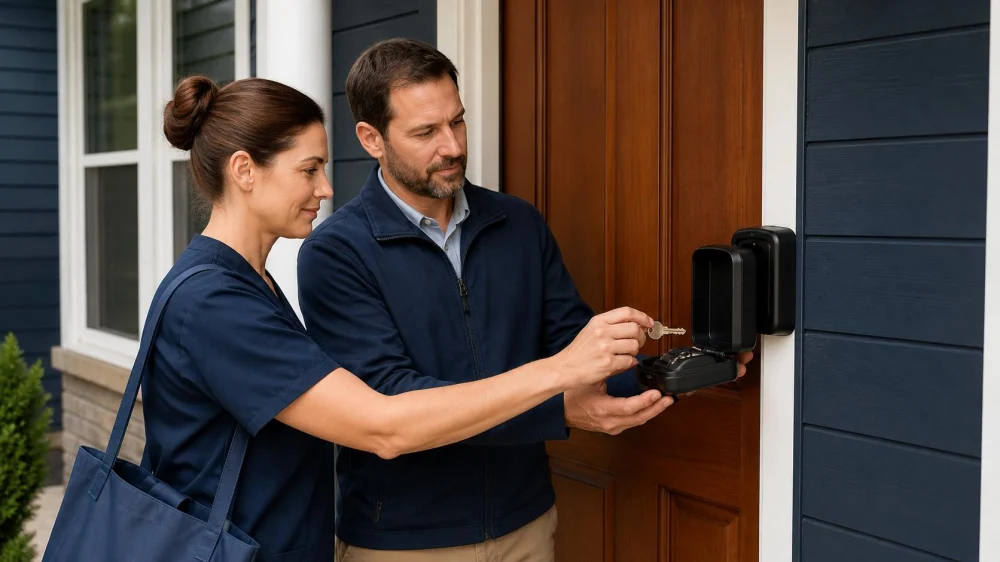
Before relying on the system, an authorized person should rehearse the whole route: reach the box safely, shield the keypad or dials, enter the code, open it, remove the correct key, operate the door, return the key, close the box, and scramble or clear the code.
Test the key while the door is open, then confirm the door latches and locks normally. Check that the box has room for the key without bending it or trapping the tag. Do not leave the box open or the code aligned after a test.
Manage visit access
Record who was authorized, the access window, and whether the key was confirmed back in place. Keep logs factual and privacy-conscious; do not put care details or alarm information in the lockbox record. Use individual temporary credentials instead when the product supports them and policy permits.
At each visit, look for damage, looseness, weather intrusion, debris, or a missing cover. Report anomalies immediately. Never transfer the code informally to a substitute worker, guest, buyer, or contractor who has not been approved.
Know when to change it
Change the code when a worker, tenant, contractor, guest, or listing agent no longer needs access; after the code is sent to the wrong person; when a phone or document containing it is lost; after suspicious activity; and on the owner’s regular schedule. End-of-service closeout should include code change or device removal.
After changing it, revoke old messages where possible, update the protected record, notify only current users, and repeat the full test. Do not assume the change worked until an authorized person verifies it.
Handle failure or compromise
If the box will not open, do not pry, strike, drill, or search for bypass instructions. Confirm the code and authorized procedure, then contact the owner, manager, manufacturer, or licensed locksmith. Use emergency services when a person inside faces immediate danger.
If the key is missing or the box shows tampering, move to safety, notify the responsible party, preserve photographs, and consider the door key compromised. The owner may need to rekey or replace the affected lock, not merely install a new box. Contact law enforcement for suspected crime or an immediate threat.
Frequently asked questions
Can one code be used for every property?
No. Reuse turns one disclosure into multiple exposures. Use a managed unique credential for each property.
Should the address be written inside?
No. The key and box are already at the location; extra identifying information increases exposure.
What if a caregiver needs urgent access?
Use the authorized care and emergency plan. Call emergency services for immediate danger rather than attempting to defeat a failed box.
Can the box stay after service ends?
Only if the owner authorizes continued use and resets access. Otherwise remove it using the approved method.
Next steps
Document owner approval, users, purpose, and expiration; inspect the mounting location; set a unique code; and complete a witnessed test. Put change triggers and failure contacts into the handoff record so the next person knows exactly how to protect access.
 KeyMe Locksmiths0.0 (0 reviews)
 Minute Key2.0 (3 reviews)
 KeyMe Locksmiths3.0 (9 reviews)
 KeyMe Locksmiths2.0 (5 reviews)
 Haley's Lock Safe & Keys4.0 (218 reviews)
 KeyMe Locksmiths4.0 (4 reviews)
 Locksmith Near Me Open Now in Anaheim CA for Fast Service
 Key Turns but Door Won’t Open? Diagnose the Lock Safely
 How Much Does It Cost to Replace Apartment Locks Near Me
 The Importance of Installing a Smart Lock on Your Dog Door
 How to Protect Your Home from Lock Cracking: Locksmith Tips for Maximum Security
 Locksmith Advice: How to Avoid Lock Replacement Scams - Locksmith Finder