
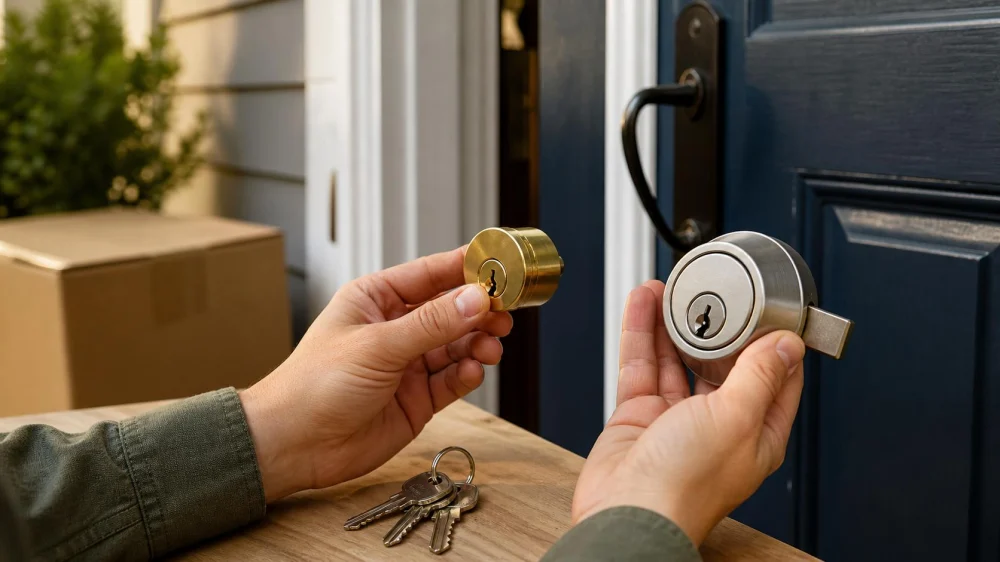
Rekey or Replace Locks After Moving? A Practical Guide
On this page
Quick answer
After moving, rekey sound locks when your main concern is that former owners, tenants, contractors, or neighbors may still have keys. Replace the complete lock when it is damaged, unreliable, poorly fitted, missing needed features, or incompatible with your access plan. A locksmith can inspect each opening and recommend different solutions for different doors.
Rekeying changes the lock cylinder so the old key no longer operates it while the existing lock hardware generally stays in place.
Rekeying vs. replacing a lock
Rekeying addresses key control. A professional changes the cylinder's internal keying and supplies a new key. It is often a sensible choice when the deadbolt and latch work smoothly, the hardware is secure, and you simply cannot account for every old key.
Replacing addresses the hardware itself. The old lockset or deadbolt is removed and a new unit is fitted. Replacement lets you correct wear, upgrade features, change finishes, or move to a different type of access system. It may also reveal door, strike-plate, frame, or alignment problems that need separate repair.

When rekeying makes sense
- The lock operates reliably: the key turns without sticking and the bolt extends fully.
- The hardware is in good condition: there is no visible damage, looseness, corrosion, or missing fastener.
- Unknown keys are the main risk: you do not know who received copies before the move.
- You want fewer house keys: compatible locks may sometimes be keyed alike after a professional checks them.
- You rent the property: the owner or property manager approves the work and retains any key required by the lease or local rules.
Rekeying is best for restoring control over otherwise serviceable mechanical locks. It is not ideal when a lock is failing, the door does not close correctly, or the existing product cannot meet the household's access needs.
When replacement is the safer choice
Choose replacement when inspection finds a functional or physical problem, including:
- a loose cylinder, cracked housing, bent latch, damaged thumb-turn, or unreliable operation;
- a deadbolt that cannot extend completely because the door and frame are misaligned;
- missing parts, improvised installation, or an opening that has been forced;
- hardware that does not provide the accessibility, keyless entry, audit, or temporary-code features the household requires;
- different, incompatible locks that cannot support the desired key plan;
- a manufacturer recall or guidance calling for repair or replacement.
Do not assume a more expensive lock fixes a weak door or frame. The opening works as a system: door construction, hinges, frame, strike attachment, alignment, and lock hardware all affect reliable operation.
Move-in lock checklist
- List every controlled opening. Include front, side, garage-entry, patio, gate, mailbox, storage, and shared-access doors where you have authority to make changes.
- Collect and label all keys. Ask the seller, landlord, or manager about copies, keypad codes, garage remotes, and community keys.
- Test from both sides. With the door open and then closed, check that each latch and bolt operates smoothly. Never lock yourself outside during testing.
- Inspect the opening. Look for loose hardware, rubbing, frame damage, exposed gaps, and a bolt that does not fully enter its strike.
- Check authority and rules. Renters, condominium residents, and homeowners in managed communities may need approval or may have requirements for master access, appearance, or fire egress.
- Choose per door. Rekey serviceable locks; replace defective or unsuitable hardware. There is no requirement to use one answer everywhere.
- Document the new key plan. Record who receives each key or code, remove old codes, and store emergency access information securely.
How to evaluate a locksmith
Describe the number and type of locks before booking and ask whether the quote covers the service call, labor, parts, new keys, and any after-hours charge. Request the business name and a written estimate. Confirm any licensing or registration rules with your state or local consumer-protection authority, because requirements vary across the United States.
Before work begins, verify the technician's company identity and review changes to the estimate. A legitimate technician may also ask for proof that you are authorized to access the property. Avoid signing forms with blank price or work fields, and obtain an itemized receipt showing the work completed.
Important limits and special cases
This is general home-security guidance, not a property-specific security assessment. Do not modify fire-rated doors, emergency exits, interconnected building access, or landlord-controlled systems without appropriate approval. Electronic and smart locks also depend on batteries, account ownership, firmware support, code management, and a reliable mechanical installation; reset ownership and credentials according to manufacturer instructions.
If a door shows forced-entry damage, will not latch, traps an occupant, or is part of required emergency egress, stop ordinary DIY work and seek an appropriate locksmith, door professional, property manager, or emergency authority. Call 911 for an immediate threat or life-safety emergency.
Frequently asked questions
Should every lock be changed on move-in day?
Every controlled exterior opening should be assessed promptly, but the remedy can differ. Sound compatible locks may be rekeyed, while damaged or unsuitable units should be replaced. Coordinate changes with the owner or manager when you do not own the property.
Does rekeying make a lock stronger?
Rekeying changes which key operates the cylinder; it does not by itself strengthen the door, frame, strike, or lock body. Ask for an inspection if physical resistance or installation quality is a concern.
Can all locks use one key?
Sometimes, but only when the cylinders and keyways are compatible and the proposed key plan is appropriate. A locksmith should identify each product before promising a single-key solution.
What should I do with smart locks left by a previous resident?
Follow the manufacturer's process to reset the device, remove previous users, transfer account ownership, update codes, replace batteries if needed, and confirm mechanical operation. Replace unsupported or untrustworthy hardware when a secure reset cannot be verified.
Evidence notes
The rekey-or-replace decision rules above reflect common professional practice: rekeying restores key control, while replacement addresses deficient or unsuitable hardware. Consumer hiring checks are consistent with broad Federal Trade Commission guidance for hiring home-service providers. Licensing, lease, building, fire, and accessibility rules can vary, so verify local requirements rather than relying on a national checklist alone.
Next steps
Walk through the property, inventory every key and code, and classify each lock as serviceable, uncertain, or defective. Use Locksmith Finder to compare local professionals, then ask the shortlisted locksmiths for written, itemized options based on an on-site inspection. The useful outcome is not simply “new locks”—it is controlled access and reliable operation at every authorized entry.

 KeyMe Locksmiths4.0 (24 reviews)
 KeyMe Locksmiths4.0 (7 reviews)
 KeyMe Locksmiths4.0 (48 reviews)
 FCL Security4.0 (28 reviews)
 Minute Key3.0 (8 reviews)
 KeyMe Locksmiths4.0 (18 reviews)
 Locksmith Tips for Choosing the Right Door Hardware
 How to Choose the Right Locksmith for High-Security Lock Installation
 What to Expect When Calling a 24 Hour Locksmith Near Me
 Can a Locksmith Near Me Fix Broken Door Locks Without Replacement | Expert Insights
 How Locksmiths Unlock Cars Without Keys Using Professional Tools
 How to Protect Your Home From Lock Picking Tools