
Door Latch, Deadlatch, and Deadbolt: What Each Does
In this guide
Door hardware names are often used interchangeably even though the parts perform different jobs. A spring latch keeps a closed door from drifting open. A deadlatching feature resists the latch being pushed back when the door is shut correctly. A deadbolt is a separate, positively operated bolt intended to add security. Understanding the parts helps a homeowner describe a problem accurately, choose compatible hardware, and avoid adding a device that complicates emergency exit.
Quick answer
A latch bolt is spring-loaded and retracts when the knob or lever operates. A deadlatch adds a small auxiliary plunger that, when held in by the strike, prevents the main latch from being forced backward. A deadbolt extends and retracts through deliberate key, thumbturn, or approved electronic operation and does not normally spring back on contact with the strike. All depend on correct alignment, a sound door and frame, compatible strikes, proper installation, and code-compliant egress from the inside.
Map the parts on a hinged door
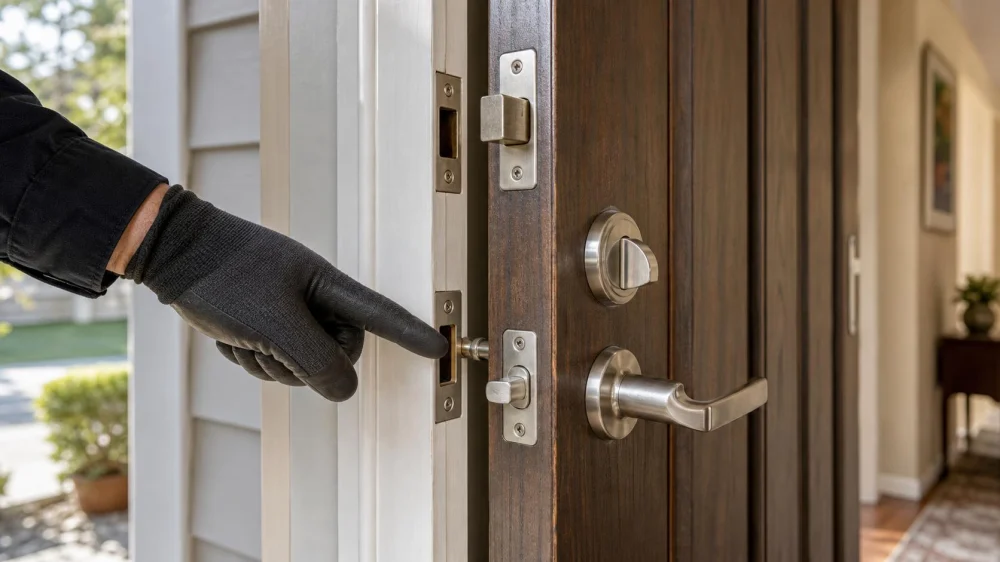
On the moving door leaf, the lock body or tubular mechanism sits inside a prepared opening. Its latch or bolt projects through a faceplate at the door edge. The knob, lever, thumbturn, cylinder, or electronic trim operates that mechanism. On the fixed frame, a strike plate surrounds the opening that receives the latch or bolt.
Hinges carry the door and control its swing. The jamb and framing behind it support the strike. Weatherstripping seals the opening. A closer, door viewer, chain, access-control device, or multipoint mechanism may add functions, but the basic relationship remains the same: moving bolt meets fixed strike.
Builders Hardware Manufacturers Association terminology describes a latch bolt as projecting into a strike to hold a door closed. Product names vary, so use photos and model information when ordering parts rather than relying on one casual term.
What a latch bolt does
A typical latch bolt has a beveled face. As the door closes, the bevel touches the strike and pushes the spring-loaded bolt into the door. Once aligned with the strike opening, the bolt springs outward and holds the door shut. Turning the inside or outside handle retracts it.
The latch provides everyday closure. It keeps the door from opening under light pressure, wind, or the pull of weatherstripping. A passage latch may have no locking function. A privacy latch may lock for a bedroom or bathroom but is not normally designed as the main security for an exterior opening. An entrance lockset can combine a latch with keyed or electronic control.
A latch that barely enters the strike may rattle, pop open, or require lifting the door. That is an alignment or condition problem, not a reason to grind away material until the opening is oversized.
What deadlatching means
Many exterior locksets use a deadlatching latch bolt. Beside the main beveled latch is a smaller auxiliary plunger. When the door closes correctly, the strike depresses the plunger while the main latch enters the strike opening. With the plunger held in, the mechanism blocks the main latch from being pushed back.
The plunger should rest on the strike plate, not fall into the strike opening beside the latch. If both enter the opening, the deadlatching function may not engage. A wide gap, incorrect strike, or misalignment can create that condition. A locksmith can assess the geometry without teaching or relying on bypass methods.
“Deadlatch” does not mean the same thing as “deadbolt.” It describes a latch feature. Some commercial hardware is itself called a deadlatch, but residential consumers most often encounter the auxiliary-plunger concept within an entrance lockset.
What a deadbolt does
A deadbolt is moved deliberately by a key, interior thumbturn, keypad, motor, or interconnected approved hardware. The bolt projects into its strike and does not use the same spring-beveled closing action as an ordinary latch. The door generally must be fully closed and aligned before the bolt can extend without binding.
Single-cylinder deadbolts use a key outside and a thumbturn inside. Double-cylinder versions require a key on both sides and can delay emergency exit if the key is missing. Codes, lease rules, insurance requirements, and local fire-safety guidance restrict where different arrangements may be used. The International Code Council has repeatedly emphasized that required egress doors should be readily openable from the inside without a key, special knowledge, or unusual effort, subject to limited occupancy-specific exceptions.
A longer bolt or higher grade cannot compensate for a split jamb, loose frame, weak door, or poor installation. Security is a property of the complete opening.
Why the strike and frame matter
The strike locates the latch or bolt and transfers force into the jamb and framing. It must match the hardware, sit at the correct height and depth, and use suitable fasteners. An oversized opening may reduce the surface that supports a deadlatch plunger. A shallow bolt pocket may stop a deadbolt before full extension.
Repeatedly slamming or lifting a door can loosen screws and enlarge holes. Settling, hinge wear, seasonal swelling, damaged weatherstripping, or a loose frame can shift alignment. Tightening a hinge may solve a minor sag, but unexplained movement, cracked framing, or a door that changes rapidly needs a broader building assessment.
Do not move a strike until you know why alignment changed. Filing one edge can hide hinge or foundation movement and may leave the hardware with insufficient engagement.
Common lockset arrangements
Passage set
A latch operated from both sides with no locking function, commonly used for closets and interior circulation where privacy is not needed.
Privacy set
An interior latch with a simple privacy function and an emergency release as designed by the manufacturer. It is not a substitute for exterior security hardware.
Keyed entrance set
A latch or deadlatch controlled by a key outside and an inside control. It may be paired with a separate deadbolt.
Interconnected lock
A lockset in which inside operation can retract both latch and deadbolt in one action. This may support egress and accessibility needs when properly selected and code-compliant.
Mortise lock
A larger lock case fitted into a pocket in the door edge. It can combine latch, deadbolt, and other functions. Replacement requires careful matching and professional installation.
Multipoint lock
A system that engages the frame at several locations, common on some tall or highly sealed doors. Its operation, adjustment, and replacement differ from a standard tubular deadbolt.
Keep emergency egress simple
Security devices must not trap occupants. Check that everyone who may need to exit—including children, older adults, guests, and people with disabilities—can operate the inside hardware in darkness and under stress. Do not hide the only key to an inside-keyed lock nearby and call that an egress plan.
Rental, multifamily, commercial, healthcare, educational, and assembly occupancies can have requirements very different from a detached home. Accessible doors may need hardware operable without tight grasping, pinching, or twisting. Fire-rated doors require listed compatible components and self-closing or latching performance that should not be modified casually.
Before adding a surface bolt, chain, smart device, double-cylinder deadbolt, or electromagnetic lock, check the authority having jurisdiction, property rules, and a qualified locksmith or door professional. More devices do not always mean safer doors.
How to choose replacement hardware
Record the door thickness, backset, bore sizes, edge preparation, handing if applicable, strike dimensions, material, swing direction, fire label, and existing function. For a mortise or multipoint lock, photograph the faceplate and every operating point without exposing keys or access codes in public.
Choose hardware certified to a relevant current ANSI/BHMA standard where appropriate. BHMA's residential deadbolt standard covers durability, security, and finish testing. A grade or certification applies to the tested product; correct installation and the opening still matter.
Match finish durability to environment, especially coastal, pool, high-humidity, or exposed locations. Confirm accessibility and egress requirements. If the door is historic, metal, fiberglass, glass, fire-rated, or heavily reinforced, professional preparation avoids irreversible damage.
Basic maintenance checks
- Close the door gently and listen for the latch to engage without lifting or pushing.
- With the door open, operate the latch and deadbolt to compare free movement with closed-door binding.
- Check hinges, faceplates, and strikes for loose screws using the correct tool and manufacturer torque guidance.
- Inspect for rubbing marks, split wood, corrosion, loose trim, and weatherstripping that has shifted.
- Use only lubricant recommended by the lock manufacturer; avoid flooding the cylinder or mixing products.
- Test keys and authorized electronic credentials, then verify that inside egress works normally.
Never close a door during testing unless you have another safe exit and a known way to reopen it. Do not force a key, thumbturn, or bolt that binds.
When to call a locksmith
Call a verified locksmith or door professional when the bolt will not extend fully, the auxiliary plunger misses the strike, the door or frame is damaged, a fire-rated assembly is involved, an electronic lock conflicts with egress, or replacement requires new drilling. Also seek help when the door no longer aligns after a break-in, impact, water damage, or structural movement.
Ask the provider to identify the failed part and verify the complete opening: hinges, door, frame, strike, fasteners, lock function, and inside release. Obtain a written description and quote before nonemergency work. For emergency calls, verify the business and technician and confirm authorization to work on the property.
Frequently asked questions
Does a latch lock the door?
A latch holds the door closed. Some latch-based locksets also restrict outside operation, but a simple passage latch has no security locking function.
Is a deadlatch as strong as a deadbolt?
They perform different roles. A deadlatch protects a spring latch from being pushed back when correctly engaged; a deadbolt is a separate positively operated bolt. Compare complete certified systems and installation.
Why does the small plunger matter?
When the strike holds it depressed, it activates the mechanism that blocks the main latch from retracting under direct pressure. Misalignment can prevent that function.
Should a deadbolt close by pushing the door?
No. An ordinary deadbolt is extended after the door is closed and aligned. Forcing the door against an extended bolt can damage the bolt, strike, frame, or door.
Can I add a second deadbolt?
Check egress, accessibility, door construction, lease, code, and insurance requirements first. A second device can complicate exit or weaken the door if poorly located.
Judge the complete opening
The latch closes, the deadlatch protects the latch when aligned, and the deadbolt adds a deliberately operated security point. Each depends on the strike, jamb, framing, hinges, door, and inside release. Learn the parts, observe how they meet, and choose certified compatible hardware without sacrificing egress. When a lock problem involves alignment or structural condition, repairing the opening is more important than simply replacing the visible cylinder.

 Vrana Lock & Safe, LLC4.0 (34 reviews)
 The Professional Locksmith5.0 (4531 reviews)
 Fred’s Key Shop & Locksmith5.0 (126 reviews)
 Bettendorf N&S Lock Inc.4.0 (122 reviews)
 KeyMe Locksmiths4.0 (198 reviews)
 Ed The Locksmith5.0 (11 reviews)
 How to Choose Between Smart Locks and Traditional Locks
 Locksmith Advice for Maintaining Smart Locks Properly
 Locksmith Advice: How to Maintain Your Locks Year-Round for Optimal Security
 What to Do If Your Door Lock Spins but Doesn’t Open
 What to Do If Your Smart Lock Fails and You Are Locked Out of Your Home
 How to Choose the Right Locksmith for Your Safe Opening Needs